

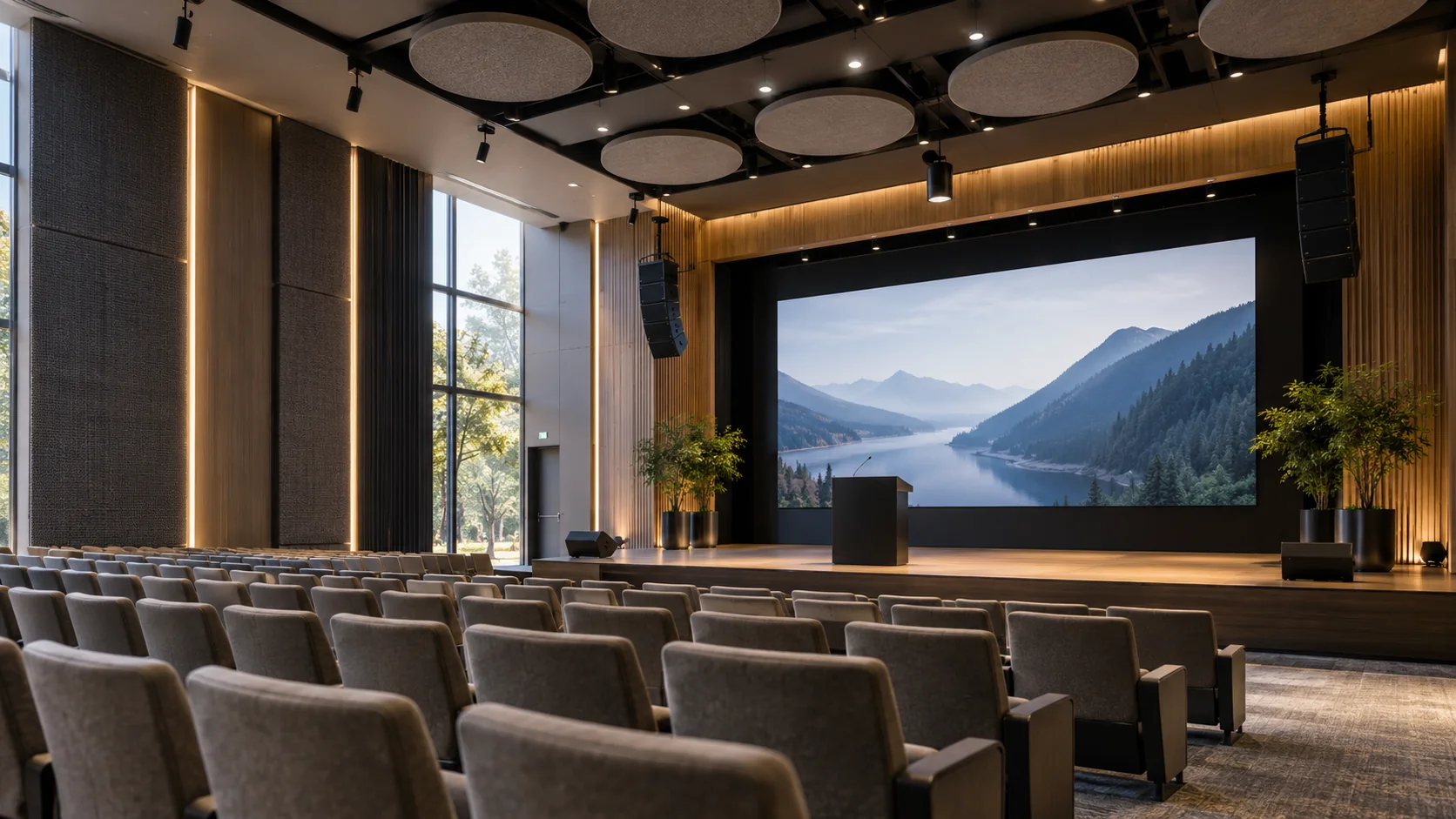
Audio is the most critical element of a hybrid meeting room: speech intelligibility, microphone coverage, echo cancellation and room acoustics directly affect whether people can understand and be understood. The room and the audio system should be designed as one environment.
1. Why audio often matters more than video
Video creates presence, but speech carries most of the information. A small reduction in image quality rarely stops a meeting; missing words, echo, noise or constantly asking people to repeat themselves creates immediate fatigue.
The objective is not simply loud sound. It is consistent, intelligible and natural speech for people in the room and remote participants.
2. What should be assessed
An effective design considers the relationship between speech and background noise, reverberation, distance between people and microphones, and loudspeaker coverage. Signal processing then needs to support the physical environment.
3. Choose microphones by coverage
Typical architectures include microphones built into video bars, tabletop microphones and ceiling arrays. None is universally better. Coverage, distance from speech, furniture and room flexibility should drive the decision.
- Video bars: efficient in compact rooms with favourable distances and acoustics.
- Table microphones: place pickup closer to participants and can provide strong intelligibility.
- Ceiling microphones: keep tables clear and work well in integrated designs, but require careful engineering.
4. Loudspeakers, DSP and acoustic echo cancellation
Sound reinforcement should be even across useful seating positions. In more advanced rooms, a DSP manages routing, equalisation, automixing and acoustic echo cancellation (AEC).
AEC prevents far-end audio reproduced by room loudspeakers from being sent back to remote participants through the microphones. Correct signal flow and configuration are essential.
5. Room acoustics comes before electronics
Glass, concrete, hard finishes and large parallel surfaces can increase reflections. Curtains, acoustic panels, ceilings, furniture and suitable materials can significantly improve intelligibility.
HVAC, equipment, doors and adjacent spaces should also be considered as sources of noise. Electronics cannot fully compensate for a major environmental problem.
6. Huddle rooms, meeting rooms and boardrooms need different approaches
| Space | Typical approach |
|---|---|
| Huddle / small room | Compact system, short audio path, operational simplicity. |
| Medium room | Detailed coverage check and possible microphone extension. |
| Large room / boardroom | Distributed audio, dedicated DSP, acoustic design and advanced commissioning. |
| Auditorium / multipurpose | Professional system designed around multiple operating scenarios. |
7. Testing should reproduce a real meeting
Commissioning is more than checking whether microphones and loudspeakers are powered. Test people in different seats, simultaneous conversation, media playback, remote participants and real operating conditions.
Audio checklist
- Background noise assessed
- Reverberation considered
- Microphone coverage verified
- Even loudspeaker coverage
- AEC configured and tested
- DSP documented
- Real scenarios tested
- Monitoring planned
Frequently asked questions
Is a video bar enough for every meeting room?
No. It can be very effective in many compact spaces, but real coverage depends on room size, participant distance, geometry and acoustics.
Are ceiling microphones always better?
No. They provide aesthetic and flexibility advantages, but require engineering, installation and tuning that match the room.
How do you know whether the problem is the system or the acoustics?
It requires listening, measurement and signal-path testing. Reverberation and environmental noise can limit performance even when the electronics are correctly configured.
Updated 19 September 2026. Technical content edited by AYNO.
AYNO
Designing or standardising meeting rooms?
AYNO supports organisations from requirements and room standards through engineering, integration, commissioning and managed services.
Talk to an AYNO specialist